
Community Engagement
▌Commitments & Policies
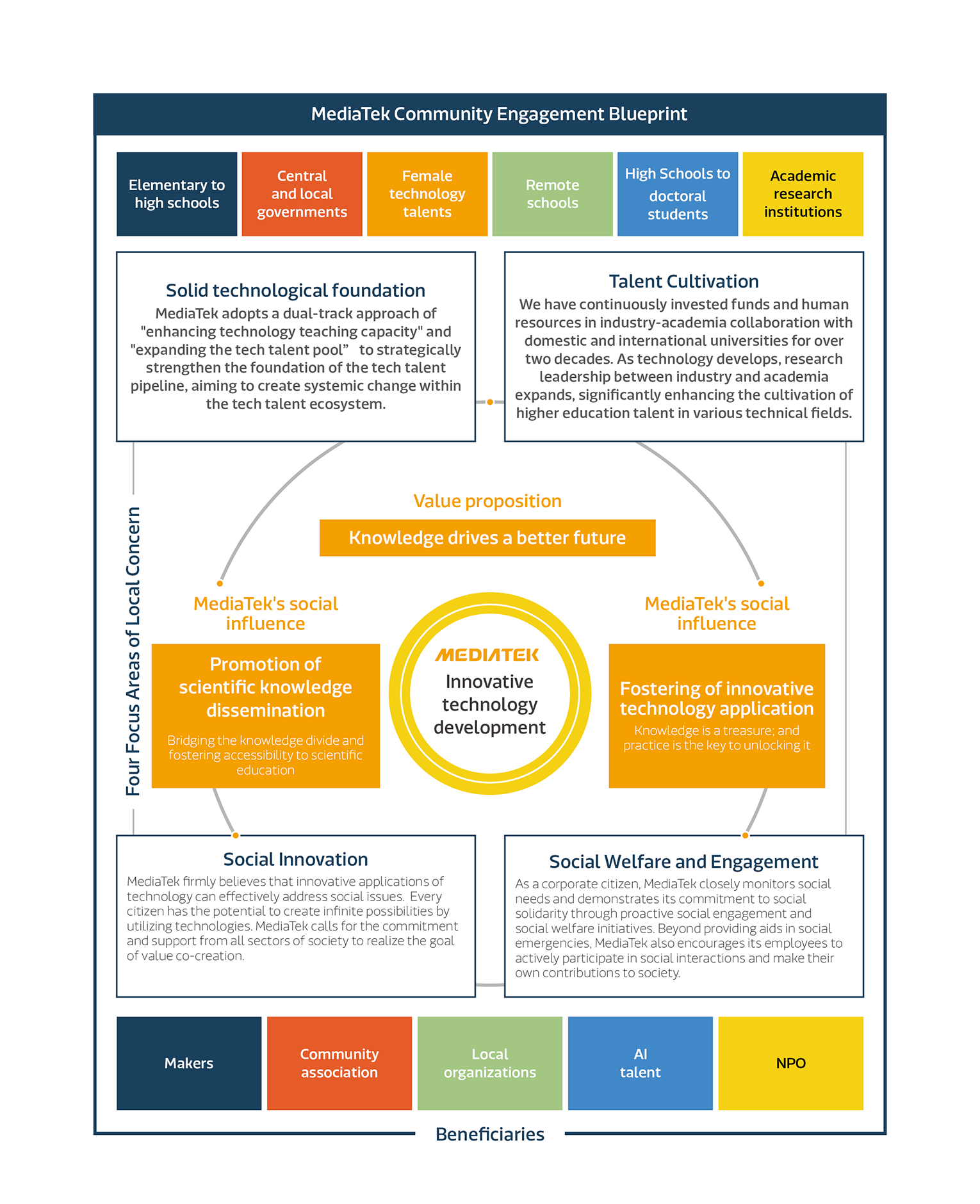
Pioneering and innovative technologies not only represent the cornerstone of our industry leadership position but also form the foundation of our social influence which relies on proactive utilization of our core capabilities in the field of technological innovation. Through cross-sector integration, we move beyond "knowledge dissemination" to "innovative application of knowledge and technology" to share the benefits of technological advancement with society. This approach enables a growing number of individuals to take advantage of the opportunities generated by technology diffusion and builds momentum toward a brighter future.
Headquartered in Hsinchu Science Park, MediaTek anchors its community initiatives in the regions where we operate—Hsinchu County and City, Tainan City, and Taipei City. To broaden our social impact, we also prioritize rural and underserved areas, aiming to balance local engagement with value co-creation.
▌Goals
| Social Innovation | Strengthen society’s digital technology capabilities to improve the capacity for solving social issues.
◢ Short-term: ● Organize campaigns as a platform for proposal presentation and refinement. We plan to offer training in technology, business models, and social impact assessment to 15 high potential social innovation teams. ● Organize cross-sector innovation workshops to promote the integration of emerging technologies with social issues, thus stimulating innovative solutions. ● Host Demo Days for teams to showcase their achievements, bridge resources and development opportunities, and support 1-3 excellent projects toward practical implementation. ◢ Long-term: ● Support the implementation of proposals and establish an impactful development blueprint; plan to support over 10 sustainably operating high-potential social innovation teams within five years. ● Establish a regional social innovation network to connect over 20 enterprises, NGOs, impact investors, and public sector entities to facilitate resource connection and exchange. |
| Solid Technological Foundation | Cultivate the next generation’s technological innovation capabilities
◢ Short-term: ● Cultivate basic-level technology course teachers for elementary and secondary schools; plan to train approximately 60 STEM teachers annually to enhance their technological/scientific teaching capabilities. ● Support 45 technology-related courses, camps, or research projects to boost students' inquiry and practical skills. ● Establish 15 local science learning circles each year, in a one school leads another model, a locally operated support system that enables resource sharing and collaborative lesson preparation. ● Address urban-rural disparities, to ensure that at least 30% guaranteed spots to support teacher capability enhancement in remote and disadvantaged areas. ● The "Girls! TECH Action" initiative annually empowers 30 parent-child groups and over 40 female university students to explore the unlimited technology career opportunities, while expanding intergenerational exchange networks and increasing corporate employee participation to form a mentorship-like support network. ◢ Long-term: ● Assist elementary and secondary schools in establishing continuous technology application clubs or courses, aiming to support over 100 schools in offering continuous technology courses within five years. ● Keep pace with the times to accelerate the adoption of emerging technologies (e.g., AI) in educational settings, thus improving teachers administrative efficiency and teaching effectiveness. ● Establish communities or exchange mechanisms to support 200 teachers in continuous professional development. ● Conduct follow-up surveys, aiming for a 30% increase in teaching confidence among participating teachers and a 20% increase in campus support (including administrative and teaching aspects). ● Publishes a research-based Girls! TECH Action whitepaper tailored to Taiwans context, to enhance advocacy and share insights and findings with society, while providing feasible case studies for teachers and parents, increasing female participation in STEM fields, and promoting womens key roles in technology. |
| Talent Development | Advance higher education and industry–academia collaboration
◢ Short-term:Support for academic research ◢ Long-term:Jointly develop cutting-edge, innovative research |
| Social Welfare and Engagement | Continue supporting arts and education initiatives
◢ Short-term: ● Build a partner network, including internal corporate volunteers and external NGOs, to launch collaborative projects. ● Promote a corporate employee volunteer culture, to encourage social participation. ◢ Long-term:Enhance networks and strengthen local connections; plan to initiate value cocreation collaboration projects with 10 local organizations within five years. |
▌Management Approach
| Responsible Unit | ◢ Social welfare projects: Planned by MediaTek Foundation Regular
reporting to the board of directors ◢ Industry-academia collaboration and cooperation with universities and professional R&D institutions: The foresighted technology strategy platform is responsible for program review and revision and supervision of implementation |
| Resources | ◢ Expenditure: NT$37.3 million, with NT$36.81 million provided for organization of events and courses, grants/subsidies, and guidance services ◢ Equipment/materials/goods donations: NT$490,000 provided in form of equipment/material/goods donations ◢ Human resources: 5 foundation staff, 82 volunteers, 16 course creators, 63 "Genius for Home" staff, 41 "GAI Promotion" staff, 46 "Girls! TECH Action" staff, and 11 "1+1 Science Circle" instructors, totaling 259 individuals. |
| Engagement Channels | ◢ MediaTek Foundation website:
http://www.mediatekfoundation.org/ ◢ MediaTek Foundation Facebook: https://www.facebook.com/mediatekfoundation/ ◢ Tel. number: 886-3-567-0766 ◢ Workshop and competition website and customer service for selected "Genius for Home" teams ◢ Online briefings for various programs |
| Evaluation Mechanism | Participant satisfaction surveys, impact outcome tracking, and disclosure. |
▌Progress and Results in 2024
| Social Innovation | In 2025, “Genius for Home”—the MediaTek Impact Accelerator—received 132 proposals, including 13 from Hsinchu County and City, the communities surrounding our headquarters. To date, proposals have reached 339 townships across Taiwan, addressing priority themes such as disaster prevention and mitigation, smart agriculture, long-term care and healthcare, and digital transformation. This year, we continued partnering with ESG allies—ASE, Arm, and Cadence—and welcomed vivo as a new partner. Together, the four companies established corporate awards and appointed executives as mentors to help social innovation teams strengthen their solutions. |
| Solid Technological Foundation | ◢ "STEM Course Maker" Program: In 2025, the program expanded to 48 elementary and junior high schools across Taiwan. Participating schools are located in the cities/counties where MediaTek operates—Hsinchu County/City, Taipei City, and Tainan City—plus 13 additional counties/cities. Courses offered include coding, IoT, and AI, benefiting 2,673 students. ◢ "Girls! TECH Action" Program: In 2025, we engaged 40 female university students and 30 parent–child pairs from junior/senior high schools in hands‑on workshops. Over 90% of participants expressed interest in considering careers in the technology industry. ◢ "1+1 Science Circle" Program: In 2025, we supported collaborative science learning across 16 elementary schools and 15 junior/senior high and vocational schools. Over the academic year, 292 teaching staff will be involved, benefiting 1,433 teachers and students. ◢ "Refurbished Equipment Donations" Program: In 2024–2025, we refurbished company end‑of‑life laptops by replacing the drives and donated 133 units to eight under‑resourced Maker‑Teacher partner schools, strengthening their foundational technology infrastructure. In 2025, we launched donations of refurbished second‑hand GPU/server equipment to 23 schools, enabling teachers and students to leverage computing power to tackle complex problems and get closer to emerging technologies. Beneficiary schools include those in Hsinchu County/City, Taipei City, and Tainan City, where MediaTek operates. |
| Talent Development | ◢ Encouragement of R&D - Support for three university-level R&D centers ◢ Formation of industry-academia alliances in line with government policies; injection of funding and teaching resources in for of industry instructors to support semiconductor college operations |
| Social Welfare and Engagement | ◢ Volunteer activities: MediaTek Volunteer Club The Club has established seven working groups: Reading & Writing, AI‑assisted Writing, Environmental Education, English Education, Science Hands‑on, Coding Education, and Stray Animal Care. In 2025, we organized the “起點文學獎” World Observer essay contest, inviting elementary school students nationwide. Twenty‑one employee volunteers promoted the program at 15 schools near our headquarters in Hsinchu County/City, hosting information sessions that reached 612 students and 35 teachers. Nearly 100 students submitted entries, fostering a passion for writing skills. ◢ "Sustainable Nanzhou" Project: In 2025, we sponsored NT$3 million and partnered with the Taiwan Good Foundation to deepen local culture and strengthen education in Nanzhou, Pingtung. Activities include arts co‑creation, publication of a local culture journal, and sustainability workshops. At least 38,461 students and local residents participated in the program. |
▌Corporate Philanthropy Focus: Cultivating Taiwan’s Future through Knowledge
Recognizing that talent is the cornerstone of competitiveness, MediaTek established the MediaTek Foundation in 2001. Guided by the core philosophy that "Knowledge drives a better future," the Foundation's operational framework is built on four key pillars: social innovation, technology cultivation, talent development, and public welfare and social engagement. With the "Theory of Change" as a strategic tool, the Foundation systematically plans and evaluates the inputs, activities, outputs, outcomes, and long-term impacts of its programs to ensure the most effective use of resources and continuous optimization of execution efficiency.
▌Digital Social Innovation
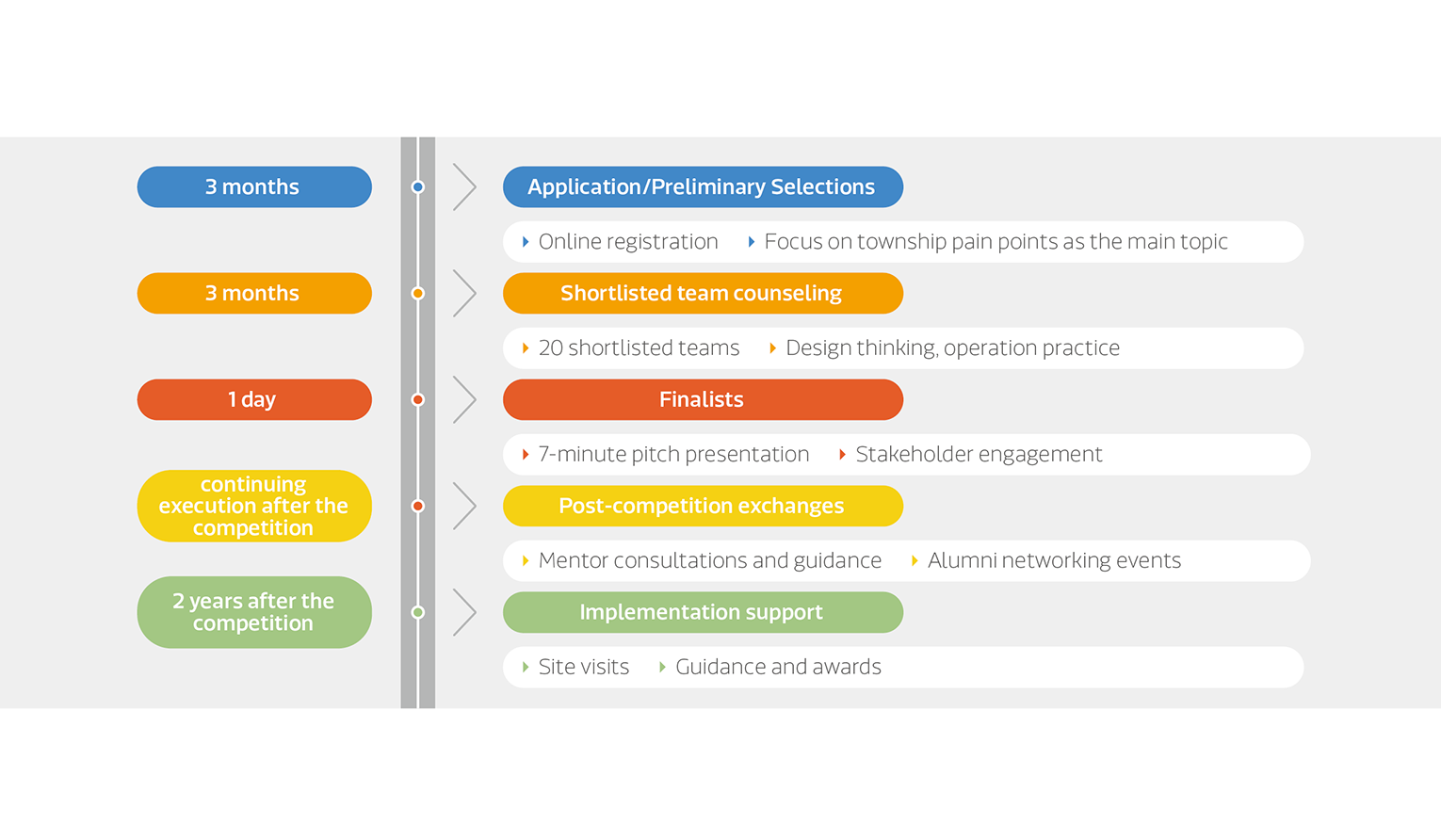
Harnessing digital technologies to address social issues is not the exclusive domain of private enterprises. MediaTek firmly believes that every citizen has the potential to create unlimited possibilities by utilizing digital technologies. In 2018, MediaTek launched the digital social innovation competition Genius for Home to encourage the public to use technology to develop solutions for issues affecting their hometowns. In addition, MediaTek supports shortlisted teams in implementing their proposals.
● Genius for Home
Practice-oriented social innovation and deep-rooted influence in local communities
Digital technology can be utilized as a tool for enhancement of problem-solving efficiency. The MediaTek Digital Social Innovation Competition titled "Genius for Home" was launched based on the fundamental belief that "everyone should make contributions to improve their hometowns". It calls on all citizens to provide solutions for social issues facing their hometowns through innovative application of digital technologies. Since its inception in 2018 to 2025, eight competitions have generated 2,600 proposals for improving local communities. "Genius for Home" is more than just a competition; among the past 124 shortlisted teams, over 40% teams have demonstrated strong determination for practical implementation after the competition, and received subsequent support to gradually implement their ideas and move toward impactful social innovation.
Submitted proposals
In 2025, a total of 132 proposals were received, and over 500 persons participated. The proposals to improve the hometown covered 339 townships and cities and touched on sustainable development issues, such as environmental sustainability, population aging, long-term healthcare, urban-rural disparity, and innovation in traditional industries, in line with the global SDGs and ESG.
Proposal submission period training
To expand social participation, proposal training workshops were offered earlier in the submission period for the first time. This aimed to lower the barrier for the public in preparing proposals. Workshops included Market Analysis Introduction and Social Innovation Proposal Workshop, to guide participants to explore issues, propose value propositions, and how to evaluate the feasibility and market demand of social innovation proposals. This helps teams interested in the competition to clarify problem contexts and prepare suitable proposals for their communities.
Ecosystem Guided co-creation
In the 2025 cohort of "Genius for Home", we continued to engage ESG partners—ASE, Arm, and Cadence—and welcomed smartphone brand vivo as a new partner. The four companies established corporate awards and appointed senior executives as mentors to help social innovation teams advance their solutions. Together with MediaTek, five companies contributed a total of 20 executive mentors in 2025 to coach the shortlisted teams.
Areas overlapping with priority locations for placemaking
The National Development Council has identified 134 priority locations (townships and districts) for placemaking. In 2024, 55 hometowns represented in the Genius for Home competition reached the promoted area earmarked for placemaking. Most of these townships (a total of ten) are located in Pingtung County, followed by Kaohsiung City (eight townships). Significantly, there were also "Genius for Home" proposals for Jianshi Township, near MediaTeks headquarters in Hsinchu City.
▌Solid Technological Foundation
To actively respond to the urgent global demand for digital transformation and talent cultivation, MediaTek has strategically established a strong foundation for the tech talent pipeline through a dual-track approach: "enhancing technology teaching capacity (teachers) " and "expanding the tech talent pool (students)". This aims to create systemic change within the tech talent ecosystem. 2024 Technology Rooting Initiative: Key Themes and Core Programs:
● STEM造課師計畫
Technology Course Innovation Accelerator: Empowering Teachers to Develop Tech Courses, Supporting Students to Solve Real Problems!
The "Course Maker" program continues to support mechatronics control programming, IoT, and AI application courses in schools. As more people recognize technology as a versatile problem-solving tool, the proportion of "non-tech field" teachers in this year's program increased to 15%. This includes science teachers leading students in building IoT devices for scientific experiments and English teachers collaborating with students to create vocabulary review robots through programming, showcasing the diverse applications of technology in schools. The program structure is as follows:
| Participants | Elementary and middle school teachers who exhibit a passion for technology education. |
| Training method | Experienced frontline professional instructors in technology education serve as mentors, to provide four-day intensive training in summer and two-day retraining in winter, and lead school visits for exchanges during semesters and various technology education observation activities. |
| Program period | 1+1 year. After one year of participation, teachers can choose whether to continue for a second year based on their needs. |
| Alumni system | After completing the two-year program, participants become Course Maker alumni. While financial subsidies cease, alumni can continue to return for winter and summer training. |
| Learning effectiveness evaluation mechanism | Regular participant surveys during winter and summer breaks assess the gap between program support mechanisms and actual teaching implementation, and impact tracking surveys evaluate the substantive effectiveness of teaching. |
● 1+1 Science Circle
This observation spurred the transformation of our program. In 2024, we launched the new "1+1 Science Circle" program. This initiative brings together a core school (elementary) with a nearby partner school (junior high/senior high/vocational school) to create a locally operating science learning circle. Teaching empowerment will be built within the core school, and learning resources will be shared across the 1+1 schools (partner schools). This approach aims to help remote schools build long-term, sustainable science teaching capacity, to ensure that both teachers and students at these schools widely benefit.
| Target participants | A "1+1"group consists of one elementary school paired with one neighboring junior high, senior high, or vocational school. |
| Role definition | ◢ Core school: An elementary school aspiring to establish a local science learning ecosystem. Its teachers and students are the main beneficiaries of this program and the school is the site where program is implemented.
◢ Partner school: A junior high, senior high, or vocational school seeking to "apply their science education knowledge, engage in mutual learning and teaching, and exert social influence". |
| Resources provided | This includes project subsidies, teacher training camps, and popular science book donations. |
● Girls! TECH Action - Tech Girls Future Design Workshop
To actively respond to Taiwan's talent development challenges and encourage female talent to embrace the tech field, the MediaTek Foundation launched the "Girls! TECH Action" program in 2023. Based on both domestic and international research on women in STEM and observations from related activities, the program focuses on junior and senior high school students and their parents, and collaborates with top universities to explore both academic and career paths simultaneously. This involves hosting "Girls! TECH Action: Tech Girls Future Design Workshop" for junior and senior high school students.
| Eligibility | MediaTek's "Girls! TECH Action" program is the first enterprise-led parent-child workshop, focusing on women in tech and reaching down to junior high school students. Research from both domestic and international literature indicates that the age of 10-14 is critical for developing interest and confidence in STEM careers. Therefore, the workshop lowers the participant age to junior high school students and invites parents, the most influential stakeholders in future university major decisions, to participate with their children. The aim is to build confidence in girls to embrace STEM fields while establishing a supportive system around them. |
| Selection process | ◢ The program selects 30 parent-child groups, totaling 60 individuals, from 8th grade through 10th grade. The goal is to inspire interest and build confidence through a two-day workshop, with a focus on academic path exploration and technology workplace experience. ◢ Recognizing that girls in regions outside of northern Taiwan have fewer opportunities to access STEM learning resources, we reserve spots for students residing in remote areas. This year, over 40% of participants came from non-six special municipalities, and selected participants received full transportation and accommodation subsidies to alleviate financial pressure on families. |
| Workshop design background | To ensure that the "Girls! TECH Action: Tech Girls Future Design Workshop" effectively impacts participants and achieves its influence goals, the activity was designed by referencing academic research and international practices. It also adopted four key design validations to provide a basis for future expansion of impact. |
▌Talent Cultivation
● Engagement in Industry-Academia Collaboration and Higher Education Talent Development
MediaTek has been engaged in industry-academia collaboration in the field of higher education since 2002 for over 20 years. The MediaTek Advanced Research Center (MARC) is in charge of the management and planning of relevant activities.
The responsibilities of the MARC include far-sighted planning and research, innovative research center operations, formation of industry-academia alliances, implementation of industrial development policies adopted by the government for high-priority areas, cooperation with domestic and international academic research institutions, and participation in top international discussion forums and technology exchange activities. Over the past over twenty years, the center has also partnered with domestic and international academic institutions all over the world, including National Taiwan University, National Tsing Hua University, National Yang Ming Chiao Tung University, National Taiwan Normal University, National Cheng Kung University, National Central University, National Chung Cheng University, National Sun Yat-sen University, National Taiwan Ocean University, National Taiwan University of Science and Technology, University of Florida, Harvard University, University of Oulu, Oregon State University, University of Mississippi, Massachusetts Institute of Technology (MIT), UT Austin, New York University, UC Berkeley, University College Dublin, Delft University of Technology, Cambridge University, Virginia Tech, KU Leuven, and University at Buffalo.
In 2024, MediaTek invested over NT$ 100 million in various domestic and international universities. Through industry-academia collaboration, we cultivated outstanding talent. In the same year, the academic institutions executed industry-academia projects, collectively published 170 papers, applied for 10 patents, and participated in various competitions, with over 33 awards. In 2024, we executed as many as 67 industry-academia projects, and 55 of them were domestic projects. Among these, nearly 40 students joined MediaTek for employment in 2024, and another 27 participating students undertook internships at MediaTek.
▌Social Welfare and Engagement
MediaTek demonstrates social solidarity through proactive social engagement and social welfare actions. Topics of concern in 2025:
● Volunteer Club
MediaTek encourages its employees to engage in social interactions to identify opportunities for practicing compassion and contributing to society.. The Volunteer Club was officially established in 2012 to expand the social influence of MediaTek through organized and systematic management. The Volunteer Club operates under a self-managed model, where members proactively identify various social issues and form corresponding subgroups to flexibly respond to societal needs. This flexible organizational structure enables the Volunteer Club to more effectively address the diverse needs of the community while inspiring employees initiative and social responsibility. Additionally, in 2015, the Taiwan headquarters officially implemented a volunteer leave policy. Starting in 2024, global employee volunteer leave was adjusted to 16 hours annually, encouraging more MediaTek employees to actively participate in public welfare activities and fulfill their civic responsibility.
MediaTek Volunteer Club The Club has established seven groups: Reading & Writing, AI‑assisted Writing, Environmental Education, English Education, Science Hands‑on, Coding Education, and Stray Animal Care. In 2025, we organized the “Starting Point Literature Award – World Observer Program” essay contest, inviting elementary school students across Taiwan. Twenty‑one employee volunteers promoted the initiative at 15 schools near our headquarters in Hsinchu County/City, hosting information sessions that engaged 612 students and 35 teachers. Nearly 100 students submitted entries, nurturing enthusiasm for writing skills.
● Sustainable Nanzhou Program
To support Taiwan’s cultural development, we partner with the Lovely Taiwan Foundation to advance a long‑term program in Nanzhou, Pingtung, deepening local culture and education. In 2025, we provided NT$3 million in sponsorship, with at least 38,461 teachers, students, and local residents participating. Program components included:
• Nanzhou Yingwang arts co‑creation: together with 14 villages and 300 residents and students, we co‑created a dyeing‑and‑weaving craft journey, culminating in an exhibition at Nanzhou Station.
• Publication series: the second volume, “南州人・庄頭生,” continued a cultural mapping effort to document the character of Nanzhou.
• Nanzhou Workshop: in partnership with Nanzhou Junior High, the “Sustainability Pillow Workshop” showcased rural sustainability through creative, aesthetic value‑add.
• “潮旅行 × 南州鄉” local immersion tours, inviting participants to experience the slow rhythms of rural life.
The initiative enriched Nanzhou’s cultural development and arts ecosystem, injecting fresh momentum into the community’s sustainable development.
● Inclusive Community Engagement
MediaTek promotes social inclusion through long-term community investment and employee volunteering, supporting locally relevant programs and encouraging colleagues to participate. Examples include our sponsorship of IC Radio’s “Zero‑Carbon Future” series, which brings the public up-to-date insights on net‑zero trends and developments, and our year‑end Christmas Wish Adoption drive, organized with local NGOs near our offices to invite employees to grant holiday wishes and support families in need.
For further details, see the “Community Engagement” section of the 2024 MediaTek ESG Report.